

19 June on Con Dao: Remembering Lê Tự Kình (1916–1964)
Every 19 June, Con Dao remembers Lê Tự Kình (1916–1964), a posthumous Hero of the People’s Armed Forces who was also known as Lê Kinh Đức. A revolutionary from Quảng Nam, he held firmly to his beliefs during years of imprisonment and died on 19 June 1964 while participating in a hunger strike against harsh prison conditions. His life connects the resistance movement in central Vietnam, underground activities in Saigon and the collective struggle of political prisoners on Con Dao.
A revolutionary from Quảng Nam
Lê Tự Kình was born in 1916 in Quảng Nam and grew up in the historically patriotic Điện Bàn area. He began participating in movements advocating the rights of local people while still young. He joined revolutionary activities in 1936 and became a member of the Indochinese Communist Party in 1937.
Before the August Revolution of 1945, he helped mobilise supporters and prepare for the seizure of power. During the resistance against French colonial rule, he held various assignments, worked to develop local networks and organised community support. Records of his life reflect a long commitment to the revolutionary movement in Quảng Nam.
Underground work in Saigon and his arrest
After the 1954 Geneva Accords, Lê Tự Kình remained in southern Vietnam rather than moving north. As the Saigon authorities sought out former resistance cadres, his organisation transferred him to Saigon to build and maintain underground networks.
There, he connected with people from the central provinces who had settled in the city. According to family recollections and accounts by former political prisoners, working as a cyclo driver gave him a legitimate livelihood and allowed him to move around, meet contacts and continue his underground work.
He was eventually identified and arrested. One family story recalls that, sensing danger, he took his youngest son out for a bowl of phở before they parted. The ordinary meal became a deeply moving memory of their final farewell.
He passed through several prisons in central Vietnam and Saigon before being sent to Con Dao. Despite interrogation and severe confinement, he maintained his political convictions.
Resisting repression in Con Dao Prison
On Con Dao, Lê Tự Kình, known to some fellow prisoners as Lê Kinh Đức, participated in collective resistance against attempts to force political prisoners to renounce their beliefs.
Prison authorities used isolation, reduced food rations, restrictions and punishment against those who resisted. Food, water and medical attention were often inadequate. Under these conditions, solidarity and organised protest were vital means of supporting one another.
Other prisoners remembered Lê Tự Kình as a determined participant in protests against harsh treatment, even as his health declined. His story illustrates the broader history of political prisoners seeking to preserve their dignity and convictions inside Con Dao’s prison system.
The 1964 hunger strike and his death on 19 June
In 1964, political prisoners on Con Dao organised a collective hunger strike against the prison regime. According to the Con Dao National Heritage Conservation Centre, the protest lasted 23 days. Lê Tự Kình took part and died while it was still under way.
Memoirs by former prisoners recount the devastating physical effects of prolonged deprivation: exhausted men could barely stand, while conditions of hygiene and medical care were extremely poor. Even so, they continued trying to support one another and sustain the collective protest.
According to these recollections, Lê Tự Kình resisted being removed from the cell even when his strength was nearly gone. In his final hours, he encouraged those around him to care for one another and to continue their struggle.
“I have become very weak. Those of you who remain, please look after our comrades and carry on the struggle.” (English rendering of a recollection preserved in Vietnamese.)
Lê Tự Kình died in Con Dao Prison on 19 June 1964, at the age of 48. Sources describing the hunger strike place his death on the fourteenth day of the protest, rather than at its conclusion. His death was a profound loss to the prisoners who had shared the struggle with him.
His resting place and 19 June remembrance
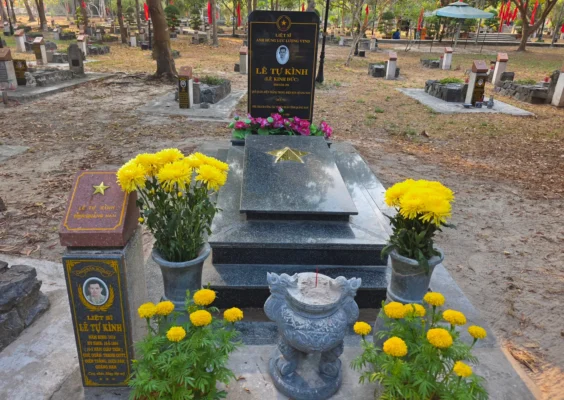
Lê Tự Kình’s grave is in Section C of Hàng Dương Cemetery on Con Dao. The cemetery preserves the memory of generations of Vietnamese patriots and revolutionaries who died during imprisonment on the island.
Every 19 June is an occasion to remember Lê Tự Kình and reflect on the lives of political prisoners who resisted harsh treatment. Visiting Hàng Dương Cemetery or Con Dao Memorial Temple offers an opportunity to pay respects and learn about his life. Formal memorial programmes, when organised, are announced separately for each year.
Honoured as a Hero of the People’s Armed Forces
On 26 April 2018, Lê Tự Kình was posthumously awarded the title Hero of the People’s Armed Forces in recognition of his contribution and sacrifice during the struggle for national independence.
In Quảng Nam, his name continues to appear in local historical materials and family memories. His life is part of the story of a generation of revolutionaries who worked underground, endured imprisonment and continued to support their comrades under enormous pressure.
The human history behind Con Dao’s prisons
Today, Con Dao is a place where visitors can learn about Vietnam’s difficult past. The surviving cells, courtyards and walls tell one part of the history. The memories of people such as Lê Tự Kình reveal the courage, mutual care and commitment that existed behind those walls.
Remembering him on 19 June means remembering a defining episode in the prisoners’ struggle of 1964. His last encouragement to his comrades has endured as part of the island’s historical memory.
Sources: History of the Struggle of Patriotic and Revolutionary Prisoners in Con Dao Prison (1862–1975), National Political Publishing House, 2010, pp. 398–400; dossier for the posthumous Hero of the People’s Armed Forces award to Lê Tự Kình; Con Dao National Heritage Conservation Centre, 62nd-anniversary memorial report, 2026; Văn Nghệ Đà Nẵng, “Đi về phía anh hùng” (2024).
Archival note: Some versions of his story describe a 21-day hunger strike, while the Con Dao heritage centre and the article in Văn Nghệ Đà Nẵng record 23 days. This article uses 23 days for the strike as a whole and distinguishes that duration from Lê Tự Kình’s death on 19 June 1964.