
5 February on Con Dao: Remembering Trần Văn Thời (1902–1942)
Every 5 February, Con Dao commemorates Trần Văn Thời (1902–1942), a posthumous recipient of Vietnam’s Hero of the People’s Armed Forces title. A dedicated revolutionary organiser and former Secretary of the Bạc Liêu Provincial Party Committee, he died in the French colonial prison on Con Dao. His life was closely connected with the revolutionary movement in southern Vietnam, and his memory remains an important part of the history of the country’s southernmost region.
From a self-taught farmer to a revolutionary
Trần Văn Thời was born in 1902 in Giao Vàm hamlet, Phong Lạc commune, in the historical Cà Mau district of Bạc Liêu province. Born into a farming family, he was known for his diligence, curiosity and closeness to his neighbours. With little opportunity for formal schooling, he used his evenings to learn to read and write the Vietnamese national script from literate people in the village.
His honesty and willingness to help others earned the trust of the community. As resistance against oppression grew in the South, those qualities helped him connect with ordinary people and gradually commit himself to revolutionary activity.
In 1936, Phạm Hồng Thám, a revolutionary who had escaped imprisonment on Con Dao, introduced him to the movement. Trần Văn Thời joined the Indochinese Communist Party in July 1937. He first worked with its Phong Lạc cell before continuing his activities in Tân Hưng, in the Lung Lá–Nhà Thể area.
Working alongside fellow organisers, he mobilised farmers, developed local networks and helped lead protests against exploitation and abuse. From modest beginnings as a labourer, he developed into a trusted revolutionary cadre.
A leading organiser in the Southern revolutionary movement
In February 1938, Trần Văn Thời was elected to the Cà Mau District Party Committee. At a provincial Party conference in May 1940, he became Secretary of the Bạc Liêu Provincial Party Committee and was appointed to the Hậu Giang Inter-Provincial Party Committee.
As a leader, he focused on strengthening local organisations, building public support and preparing for armed resistance. With French colonial authorities intensifying repression, he emphasised careful assessment of the balance of forces, thorough preparation and the need to choose the right moment for an uprising.
His name is associated with revolutionary activities in Cà Mau and Bạc Liêu, including preparations surrounding the Hòn Khoai Uprising of 13 December 1940. After the subsequent repression, he and other revolutionaries worked to preserve their networks in the U Minh forest area.
Arrest, deportation and death on Con Dao
In 1941, Trần Văn Thời was assigned to work in Châu Đốc and continued his activities underground. He used the name Nguyễn Văn Chất to protect his identity from French colonial police.
In May 1941, following information supplied to the authorities, he was arrested with several comrades and taken to Sa Đéc. Despite severe interrogation and torture, he refused to reveal information about his organisation or fellow activists. A French colonial court sentenced him to ten years of imprisonment and fifteen years of exile, and he was sent to Con Dao.
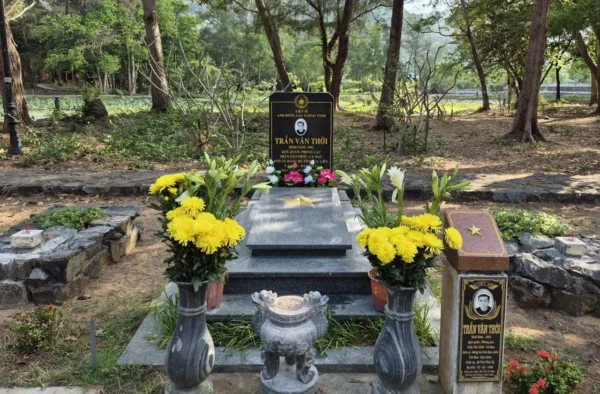
The injuries he had sustained, together with harsh imprisonment conditions, steadily undermined his health. According to the Con Dao National Heritage Conservation Centre, Trần Văn Thời died in prison on 5 February 1942, at the age of 40. His death was a major loss to the revolutionary movement and the people of Cà Mau, and his steadfastness under persecution became a lasting example of personal courage.
5 February and remembrance on Con Dao
Con Dao preserves the memory of generations of Vietnamese patriots and political prisoners who were confined or died in the colonial prison system. Among the people remembered here is Trần Văn Thời.
On 5 February 2015, a ceremony marking the 73rd anniversary of his death was held in Section D of Hàng Dương Cemetery. Representatives of local authorities, former political prisoners and island residents took part. Another commemoration took place at the Con Dao Memorial Temple on 5 February 2017, marking the 75th anniversary.
These commemorations offer an opportunity to honour those who lost their lives and to pass on a more complete understanding of Vietnam’s history. 5 February each year is a day to remember Trần Văn Thời; the date does not, by itself, confirm that a formal public ceremony takes place every year.
A name remembered in Cà Mau
In 1948, a newly established administrative district in the U Minh region was named after Trần Văn Thời to honour his contribution. His name has since also been used for roads, schools and commemorative places in the southern provinces.
In 2011, he was posthumously awarded the title Hero of the People’s Armed Forces. From a self-taught farmer to a provincial revolutionary leader, his life reflects determination, a commitment to his community and the difficult choices made during the struggle for national independence.
Remembering the lives behind Con Dao’s history
Each 5 February, Trần Văn Thời’s story offers a way to understand a painful but resilient chapter of Vietnam’s past. Remembering individual lives alongside the island’s prison buildings and historical sites helps preserve the human experience behind those places.
Sources: Hero of the People’s Armed Forces dossier for Trần Văn Thời; History of the Bạc Liêu Provincial Party Organisation, Volume I (1927–1975), Bạc Liêu Provincial Party Committee, 2002; Con Dao National Heritage Conservation Centre, reports on commemorations of Trần Văn Thời.
Historical note: Some biographical sources give other dates for his death. This article follows the 5 February date used in the Con Dao heritage centre’s records and commemorative activities, while acknowledging that the archival discrepancy remains.